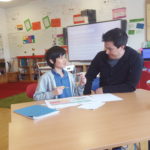
This morning we had our first Child Protection lesson with Ms. Jill. To begin the lesson, Ms. Jill taught the students a mindfulness breathing technique called “Sixteen Seconds”. She presented this technique as a way students could help themselves settle down when they felt awkward or uncomfortable. In addition to encouraging the students to use this technique, she gave students permission to step out of the room for a few minutes if they were uncomfortable at any point. She then made sure that students understood that the purpose of these child protection lessons is to teach them things that will help them be safe.
The topic of today’s lesson was communication. The students discussed three types of communication: aggressive, passive, and assertive.
These are notes the students made with Ms. Jill:
- Aggressive Communication:
- Threatening
- Disrespectful (words, tone)
- Rude (words, tone)
- Ignoring
- Physical (punching, hitting, kicking, shoving, choking)
- Takes care of ME (not taking care of other people)
- Passive Communication:
- Avoid communicating
- Ignoring (so that you don’t have to deal with something)
- Letting people get their way
- Takes care of OTHERS
- Assertive Communication:
- Involves both what you say AND how you say it. Tone of voice matters. Body language matters.
- Uses “I” messages in order to communicate what you feel, think or need. Ex: “I feel sad when I hear rude words because they hurt my feelings. I like playing with people who use nice words”, or, “I feel upset when you do not take care of my things because I then need to replace them. I need you to take care of my things like I do if you are going to borrow them.”
- Includes active listening (listening with your whole self). This means using good eye contact (not staring or glaring), speaking in a calm, even tone of voice, paraphrasing what you heard the other person say, clarifying anything that is not clear, and asking non-judgmental questions.
- Can communicate a firm message in a way that gets the point across but helps everyone feel respected.
- Takes care of EVERYONE
After discussing the different types of communication, Ms. Jill and individual students role-played different kinds of communication in everyday situations (i.e. you need to get your pencil back from someone who is using it) and then discussed that you might have to use assertive communication in situations to keep yourself safe.
Then, students practiced active listening in pairs, first with an everyday conversation (i.e. about the weekend) and then when discussing a conflict.
At the end of the lesson, we answered questions and talked about individual situations. Some interesting tips/thoughts that came from the wrap-up discussion:
- In these discussions, everyone has the right to say “no” if they are asked to share their thoughts or role-play in front of the group.
- “I” messages work best when you’ve had a chance to calm down, rather than in an angry moment. The breathing technique we learned at the beginning of the session is one way students can help themselves calm down to a level where they can use “I” messages effectively.
- When working to solve a conflict, don’t say “always” or “never” , i.e. “You ALWAYS say you’re going to give me a turn and then you NEVER do!”
Our next session with Ms. Jill will be Thursday. I will blog again then so that parents stay informed of what we discussed in class.